Prospecting systems your firm owns

Your strongest prospects, ranked for today.

We combine ongoing market research with your desk’s notes and deal history to rank prospects by timing, fit, and potential deal size. Your CRM opens with the calls to make and matching email drafts ready in Outlook.

Book a call

Client work

  • Colliers

A prospecting system built for your desk

Your market, continuously researched
We build and maintain your market list from public records, company information, and licensed sources, or work from the list you already trust.
Your private knowledge gives it context
We connect the research to your contacts, lease records, past notes, and deal history.
Your priorities determine the ranking
Timing, fit, relationship history, and potential deal size shape the day’s outreach.
Email automation built around your desk
Voicemail follow-ups, check-ins, and market updates use your templates. Drafts arrive in Outlook for you to review and send.

Your firm owns the system. We train your team to run it.

Less CRM upkeep between calls

Past notes become lease timing, requirements, and follow-up dates in your CRM. Market research adds context and flags company moves or contact changes for review.

The records

Your market

Your CRM history

Past notes, lease records, requirements, and deals

Market research

Occupiers, properties, moves, and contact changes

Each morning

Calls and email drafts

Ranked by timing, fit, and potential deal size, with a reason for each call. Matching email drafts are ready for review.

Your brokers

Calls and notes

Callback notes schedule follow-ups. Active requirements move out of general prospecting and into deal follow-up.

New notes shape the next day’s outreach
Market research and CRM history inform ranked calls and email drafts. Brokers’ notes shape the next day’s outreach.

Reach decision makers directly

The market list identifies occupiers, business owners, and operations managers in your territory, with direct phone numbers and emails where available. You can see where each detail came from and what still needs checking.

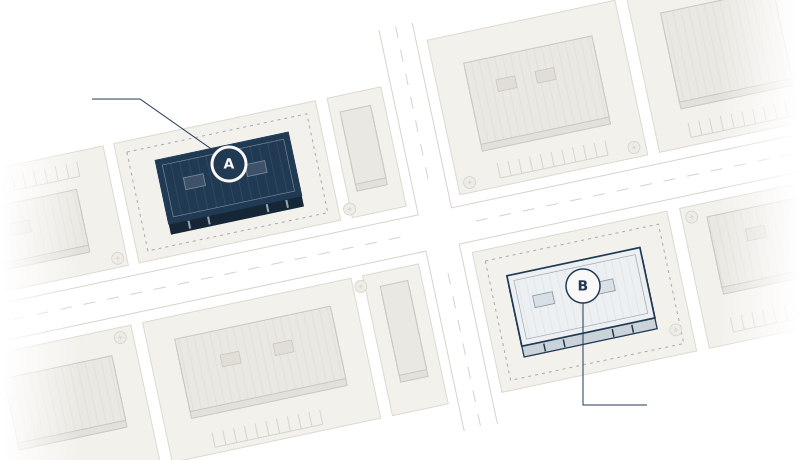
An illustrative commercial district with two premises marked for business and contact research.

Businesses

Occupiers and addresses

People

Names, roles, and contacts

See where the market data comes from

Research is scoped to your territory, property types, and target occupier sizes. These North Vancouver records show the kinds of sources we use.

Properties and land
ParcelMap BC identifies parcels. Municipal maps add zoning and building information. Registered ownership can be checked through a separate title search when the assignment calls for it.
Businesses and locations
Business licences connect names to addresses. OrgBook BC supplies registered names and status. Company location pages, map listings, and dated signage help check the business at the premises.
People and contact details
Company websites publish names, roles, and business numbers. Licensed contact databases add named contacts and direct phone or email details where available, through a subscription held by your brokerage.
Activity at a property
Building permits describe work at an address. Published moves, sales, and changes in signage can give your team a reason to investigate.

Your contacts, conversations, lease expiries, listings, and deal history give these market records their context. Lease dates and private deal information come from your team’s records and sources your brokerage is licensed to use. Where a city publishes licence history, it can indicate how long a business has been recorded at an address; it does not establish a lease expiry.

How contacts and locations are checked

Names and roles come from company sources and licensed contact databases. Business confirmation is shown separately from contact details.

Callable
Business name, address, and local activity confirmed, with a number published for that location.
Lead
A business identified at an address, with evidence still needed before it joins the call list.
Gap
An address where the occupier is still unknown, grouped by street so you know where to look.

Published numbers and independently verified numbers are marked separately. Supporting records are available to review, with conflicting details flagged.

How the installation runs

  1. Define Agree on your territory, target occupiers, and outreach priorities. Receive a written plan with prices within days of the conversation. No cost to start.
  2. Build We connect the market research, your CRM records, and your email templates. You review the ranked prospects, draft messages, and supporting records.
  3. Refine Your brokers try the calls and email drafts in their daily work. We adjust the ranking and follow-ups before your team signs off.
  4. Handover Your team is trained to run it. Everything built is yours, with no studio subscription. CRM, data subscriptions, and other running costs are paid separately.

FAQ

What does it cost?

The daily system is scoped and priced in a written plan. The first call is free. Email drafting is part of that system. A standalone market sheet has a separate fixed fee quoted in writing and is yours to keep.

We already use CoStar, REHQ, or a dialer.

Keep the market list and data sources you trust. We connect market research with your private records to prioritize both calls and email drafts. If your current setup already does that, start by identifying what work is still left to do.

What does the system need from us?

Your market records, CRM history, email templates, and access to Outlook drafts. During the installation, your brokers review the priorities and messages so both reflect how your desk works.

What can the research uncover beyond lease expiries?

Changes in occupiers, tenant improvement permits, and announced moves or closures give your broker reasons to investigate. Where available, ownership records can also identify possible owner occupiers.

Lease dates and deal terms come from your team’s records and licensed sources. The wider research can prompt a conversation even when an expiry is unknown.

What happens to our data?

Your records stay in your CRM. The system writes in fields of its own, never edits your brokers’ notes, and never deletes data. Facts supported by records are added; inferences and new contacts are proposed for your team to review. More on the Security and data page.

See the prospecting system at work

In a free, 30-minute call, we’ll show you how the prospecting system works, discuss your team’s current setup, and explain what an installation would involve. If the fit is there, a written plan with scope and prices follows within days of the call.

Book a call

Prospecting at work

Illustrated with a fictional company.

This is an illustration of fictional streets, businesses, people and a brokerage desk. Names, dates and records throughout are made up.

Provenance Studio helps commercial real estate brokers know who to call. An architectural street drawing builds from outlines, windows and entrances.

Every night, we research the businesses the desk wants to reach. A check passes over each building on the street. At the building Westhaven Foods occupies, a dashed outline of a proposed four-storey building rises over its warehouse. A city planning record, filed 29 September 2026, holds the redevelopment application.

The view moves into the warehouse. One record shows who is there: Westhaven Foods, the occupant named by the city business licence, and Maya Chen, the general manager named on the company’s website, both checked on 28 September 2026.

We combine that research with the desk’s notes. The desk’s original note, dated 14 February 2026, says Maya’s lease ends in March 2028 and that the desk helped with her last move.

Every morning, the desk knows which ten people to call and why, in its existing CRM. The list shows ten people, each with a reason. March 2028 moves from the note into Maya’s row, next to the redevelopment application. The other nine reasons are a lease ending in 14 months, a second site opened, a callback due today, a nearby building sold, a new operations manager, a relocation notice online, a for-lease sign at their building, a lease ending in 11 months and their building listed for sale. Maya’s call then opens with both reasons and their sources, and a suggested opening asks whether she has seen the plans for her building; it does not assume she will move.

After the call, the broker’s note says to email Maya the options and call her on 8 October. An email draft with the options is prepared and marked ready for review. A copy of the 8 October date moves from the note into a scheduled callback, and the note keeps its original words. The broker reviews the email before sending it, and the original note stays with the record.

Your book stays yours. Maya’s relationship, the desk’s notes, lease dates and callbacks sit inside a boundary that is private to the desk’s senior broker and associates.

We build your software. Your desk owns it. The closing invitation is Book a call at provenancestudio.ca, over the architectural street. A licensed instrumental recording accompanies the finished film. There is no spoken narration.